
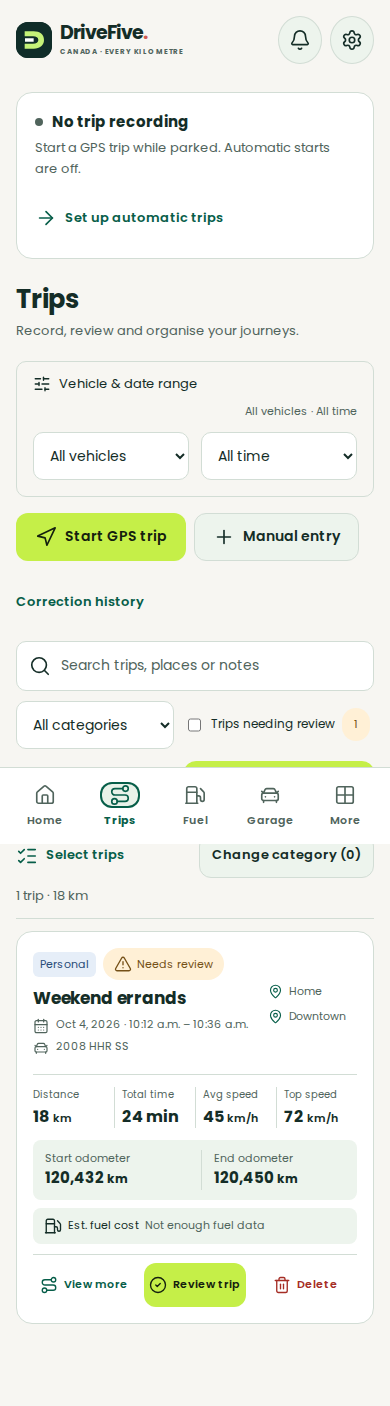
The message protects you from a made-up cost
A trip fuel-cost estimate combines three recorded facts: trip distance ÷ 100, the vehicle’s earlier L/100 km and an earlier CAD-per-litre price. If any required part is unavailable, DriveFive explains the gap instead of substituting a generic vehicle rating, a current pump price or zero.
The estimate uses only eligible fuel records dated before the trip. It does not reach forward to a later purchase. It also belongs to the same vehicle as the trip, so fuel logged under another garage vehicle cannot supply the missing history.
The three inputs DriveFive needs
| Required input | Where it comes from | What can make it unavailable |
|---|---|---|
| Trip distance | The saved trip | No usable distance or an unfinished record |
| Fuel consumption | Up to the last three complete full-to-full intervals before the trip | No closed interval, a missed fill or an invalid odometer sequence |
| Fuel price | The latest earlier fill-up with valid litres and a recorded cost | No earlier usable price for that vehicle |
Consumption uses total litres divided by total kilometres across the eligible intervals, then multiplies by 100. Partial top-ups between two full fills count in the interval. The first full fill usually establishes the starting point; another suitable full fill is needed to close the first interval.
If only one or two complete intervals exist, DriveFive can use those. With three or more, it uses the last three before the trip. The price can come from a full or partial fill, as long as that earlier entry has valid litres and a recorded cost.
Six common reasons the estimate is unavailable
- The trip has no usable saved distance yet. Finish and review the trip record before troubleshooting fuel history.
- There is only one full-tank entry. That entry opens an interval but does not close one.
- A fill-up between the two full tanks is missing, or an entry is marked as a missed fill. DriveFive does not present an incomplete interval as reliable consumption.
- An odometer reading is inconsistent, decreasing or attached to the wrong vehicle, so the interval cannot provide a valid distance.
- No earlier fill-up has both valid litres and a recorded cost. A later purchase cannot price an earlier trip, and same-day fills are excluded because reliable fill times are unavailable.
- The trip belongs to a battery-electric vehicle. The fuel-only estimate is not applicable; charging remains a separate recorded cost.
If a newer earlier fill-up has litres but no price, DriveFive can use the previous usable earlier price and show its date. A recorded zero remains zero; an unknown amount remains unknown. These are different facts and should not be exchanged.
Worked example: enough history for an 18 km trip
Consider fictional records for one gasoline vehicle. The amounts are sample values in Canadian dollars, not current pump prices.
| Record | Odometer | Fuel information | Role |
|---|---|---|---|
| Full fill · August 30 | 50,000 km | Tank marked full | Opens the interval |
| Partial fill · September 15 | 50,200 km | 20 L | Included in the interval |
| Full fill · September 30 | 50,500 km | 25 L at $1.70/L | Closes the interval and supplies a price |
| Trip · October 4 | After the fuel records | 18 km | Trip to estimate |
The complete interval uses 45 L over 500 km: 45 ÷ 500 × 100 = 9.0 L/100 km. The 18 km trip then uses 18 ÷ 100 × 9.0 × $1.70 = $2.754, rounded to an estimated $2.75.
Remove the September 30 full fill and there is no closed interval. Keep that fill but remove every usable earlier price and the consumption may still exist while the cost estimate remains unavailable. A purchase on October 10 does not rewrite the October 4 estimate.
Check the message and supporting records in DriveFive
- Open Trips, choose the correct vehicle and date range, then find the trip showing Not enough fuel data.
- Choose View more and read the fuel-estimate explanation. Confirm the trip has a saved distance and belongs to the intended vehicle.
- Open Fuel for that same vehicle and inspect entries before the trip date. Look for the earlier full fill that opens an interval, every partial fill within it and the next full fill that closes it.
- Check litres, full-or-partial status, missed-fill flags and odometers against receipts and the vehicle’s records. Correct only entries that are actually wrong.
- Confirm that at least one eligible earlier fill-up has valid litres and a known total or pump price. Leave an unknown cost blank rather than guessing.
- Return to the trip and open View more again. The breakdown shows the consumption record dates, number of intervals, fuel price and price date when the inputs are available.
If a fuel purchase was genuinely omitted and you still have its date, litres, odometer and receipt, add the historical entry accurately. If those facts cannot be recovered, preserve the gap. The unavailable message is the correct result for incomplete evidence.
Treat the result as an estimate, not a recorded expense
The calculation estimates fuel used by one saved trip. It does not create a fuel purchase, add money to expense reports or represent maintenance, insurance, parking or total vehicle ownership cost. Recorded spending continues to come from actual entries.
Natural Resources Canada notes that fuel use varies with acceleration, speed, vehicle condition, weather, traffic, roads and powered accessories. DriveFive bases the estimate on your earlier records rather than a generic published rating, but a historical average still cannot predict every trip exactly.
Use the estimate as a clearly labelled reference. When it is unavailable, follow the explanation to the missing input, keep the records truthful and let the blank value show that the supporting history is incomplete.
USE IT IN DRIVEFIVE
Your next step
Open the matching guide for the exact steps in the app.
- Read trip cards and fuel-estimate details
- Check full, partial and missed fill-ups
- Understand recorded totals and exports
Sources & app documentation
- DriveFive: fuel and vehicle expenses
- DriveFive user guide: trip fuel-cost estimates
- DriveFive user guide: fuel entries and consumption
- Natural Resources Canada: understanding fuel consumption ratings
- Ressources naturelles Canada : comprendre les cotes de consommation
Published by DriveFive · App instructions checked against version 1.27.0. Read our editorial approach.